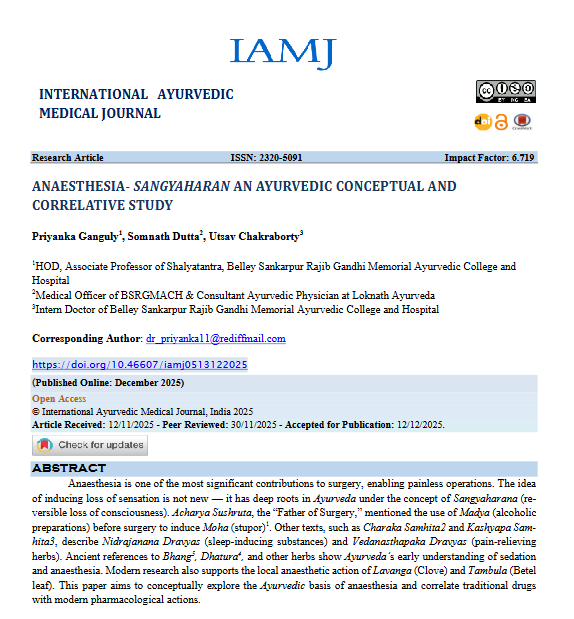
Anaesthesia – Sangyaharan: Ayurvedic Conceptual and Correlative Study
Anaesthesia plays a crucial role in clinical practice to ensure painless procedures, comfort, and safety. While modern medicine relies on pharmacological agents for anaesthesia, Ayurveda provides its own classical insights through the concept of Sangyaharan — mechanisms and techniques that suppress sensation to facilitate painless therapeutic interventions.
Dr. Somnath Dutta (B.A.M.S.), an Ayurvedic physician and clinical researcher practicing in Raiganj, Uttar Dinajpur, West Bengal, has published a peer-reviewed article titled “Anaesthesia – Sangyaharan: An Ayurvedic Conceptual and Correlative Study” in the International Ayurvedic Medical Journal (IAMJ). This conceptual research bridges classical Ayurvedic theories with modern anaesthesia understanding, highlighting the scientific relevance and clinical insight of ancient principles.
Understanding Sangyaharan in Ayurveda
In Ayurveda, Sangyaharan refers to the suppression of sensory perception to prevent pain and discomfort during therapeutic procedures. Classical texts describe methods to reduce dosha and sensory stimulation, often using medicinal formulations and techniques to create a state similar to modern anaesthesia.
The research article explores:
- Ayurvedic descriptions of sensory control
- The relationship between dosha balance and pain perception
- Classical formulations with sedative and analgesic properties
- Theoretical similarities with modern anaesthesia mechanisms
By examining classical sutras and logical correlation with contemporary biomedical science, the study presents Sangyaharan as a conceptual bridge between historical wisdom and present-day clinical practice.
Correlation with Modern Anaesthesia
Modern anaesthesia employs drugs that affect the central nervous system to induce unconsciousness and analgesia. While these agents are not directly mentioned in Ayurvedic texts, the research highlights functional parallels with Ayurvedic herbs and rasayanas that:
- Reduce sensory stimuli
- Modulate nervous system responses
- Support stress relief and sedation
This study provides insight into how Ayurveda’s holistic view can offer alternative conceptual frameworks for understanding pain control and sensory modulation.
Research Relevance and Contribution
The article contributes to both Ayurvedic scholarship and integrative medical knowledge by:
- Providing textual analysis of classical concepts
- Drawing scientific correlations with modern anaesthesia
- Encouraging research in Ayurvedic pharmacology and surgical support
- Enhancing evidence-based understanding of traditional practices
Dr. Dutta’s work exemplifies deep academic engagement with classical Ayurvedic thought while remaining sensitive to contemporary clinical relevance.
Access the Published Article
🔗 International Ayurvedic Medical Journal (IAMJ)
https://iamj.in/article/d1113ae0-ed3d-41cf-811f-b59f0f8477b9
